Book: Acoustic and Electromagnetic Scattering
Acoustic and Electromagnetic Scattering Analysis Using Discrete Sources
Adrian Doicu, Yuri Eremin and Thomas Wriedt
- Link (8 Apr 2013)
Coupled-dipole simulations of sparse plasmonic nanoparticle assemblies using the cda package - Update 2013
Baptiste Auguie

Ray-tracing rendering of 3D clusters of plasmonic nanoparticles with arbitrary positions, sizes, and orientations.
Brief description
The cda package implements the coupled-dipole approximation for electromagnetic scattering by sparse collections of subwavelength particles, with a particular focus on plasmonic nanoparticles in the visible regime. The interaction matrix, and the solution of the linear system of coupled-dipole equations are executed in C++ code for speed; convenient wrapper functions are provided at the R level to generate the particle clusters, calculate the extinction, scattering, and absorption of light by particles with linearly and circularly polarised light. Functions are also provided to calculate orientation-averaged circular dichroism, and display clusters of nanoparticles in three dimensions using OpenGL or povray.
Mathematica GLMT
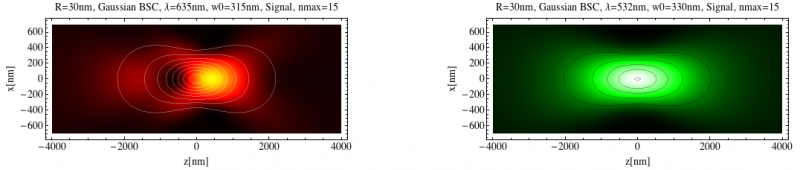
These Mathematica script files by Markus Selmke allow the extensive study of light-particle interaction phenomena enountered in coherent focused beam illumination of spherical (multilayered) scatterers, e.g. to compute the intensity collected by a detection microscope objective and recorded with a photo-diode, radiation pressures, the rel. photothermal signal, sopectra, Poynting vector flows and near fields among other things.
- Link (23 Nov 2011)
pymiecoated
A Python code for computing the scattering properties of single- and dual-layered spheres with an easy-to-use object oriented interface.
Based on code by C. Mätzler; ported and published with permission.
Requires NumPy and SciPy.
- Link (05/11/2012)
EMTL
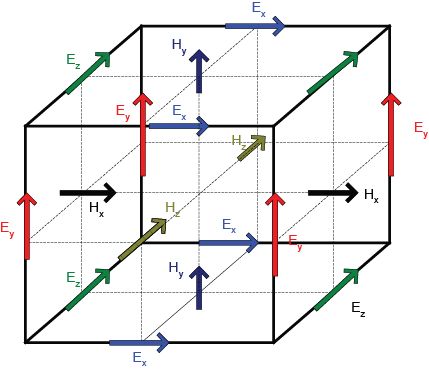
Electromagnetic Template Library (EMTL) is a free C++ program for electromagnetic simulations. The current version of the program is designed for quick and efficient programming of FDTD simulations and for extending the available FDTD algorithms with new techniques and features.
- Link (18 Oct 2012)
Multiscatter
Lidar is affected by multiple scattering in any optically thick medium, particularly liquid clouds. Millimetre-wave radar is typically only affected when observing deep convective clouds from space. One approach to deal with this problem is to use a variational retrieval algorithm with a forward model that can represent multiple scattering while being both accurate and fast. This code is such a forward model, and consists of two algorithms.
- Link (18 Oct 2012)