Library with the filtered Green's tensor by Nicolas Piller.The filtered Green's tensor is a modified Green's tensor developed to improve the accuracy of the coupled-dipole approximation (CDA) or discrete-dipole approximation (DDA).
Reference:
N. B. Piller and O. J. F. Martin, Increasing the performance of the Coupled-Dipole Approximation: A spectral approach, IEEE Antennas and Propagation, August 1998.
- Original link (28 Nov 2008, offline)
- Local copy (16 Mar 2009)
ADDA is a C software package to calculate scattering and absorption of electromagnetic waves by particles of arbitrary shape and composition using the discrete dipole approximation (DDA). The particles can be located in a homogeneous medium or near a plane substrate; emission (decay-rate) enhancement of point emitters can also be calculated. The main feature of ADDA is the ability to run on a multiprocessor system or multicore processors (parallelizing a single DDA simulation). It can also employ modern GPUs to accelerate computations. ADDA is intended to be a versatile tool, suitable for a wide variety of applications ranging from interstellar dust and atmospheric aerosols to metallic nanoparticles and biological cells. Its applicability is limited only by available computer resources.
This software is available under GNU GPL 3. Full source code, Windows binaries, and extensive documentation are available.
- Link (11 July 2018)

Library with the filtered Green's tensor by Nicolas Piller.
The filtered Green's tensor is a modified Green's tensor developed to improve the accuracy of the coupled-dipole approximation (CDA) or discrete-dipole approximation (DDA).
Reference: N. B. Piller and O. J. F. Martin, Increasing the performance of the Coupled-Dipole Approximation: A spectral approach, IEEE Antennas and Propagation, August 1998.
- Original link (27 Nov 2008)
- Link (local copy)
Discrete Dipole Approximation - Review and Advances by B. T. Draine and P. J. Flatau.
The Discrete Dipole Approximation for Scattering and Absorption of Light by Irregular Particles.
- Link (27 Nov 2008)
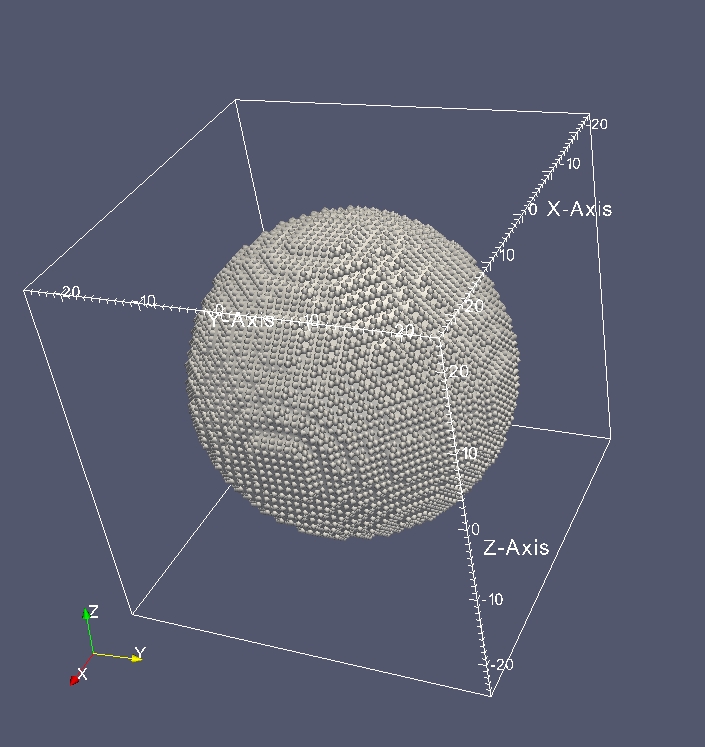
Conjugate gradient FFT volume integral method FORTRAN program printed in
Manuel F. Catedra, Emilio Gago, Luis Nuno, 3 D BODY Computer Code
in W. Ross Stone (Ed.) Radar Cross Section of Complex Objects, IEEE Press, New York 1989 p. 150-183 (pages 160 and 161 interchanged!).
- Link (local 15 March 2021)
A version of Catedra's FORTRAN code (CG-FFT) including a Matlab 5.2 Graphical User Interface is available from Aharon Blank.
- Original link (20.7.2005)
- Link (local copy)
Volume Integral Equation code by by Jouni Peltoniemi.
- Original link (offline)
- Link (local copy)